|
Introduction to Political Violence in Cambodia
Over the past thirty years, Cambodia has fallen into a deep political hole. Through a series of long, politically violent movements, violent solutions have been used to resolve issues in Cambodia, and this has created a violent culture for our Buddhist country. The bed of peace of Buddh ist culture was destroyed to almost zero. It became a big question to all Cambodians how Buddhists could commit such massive crimes on humans and destroy their own religion? Today, there is still no clear answer to these questions. The 1991 Peace Accords allowed Cambodians to breathe in peace gradually, and Buddhism has re-established its role in the country and contributed to the practice of peace among diverse political parties. The Dhammayietra ("Walk for Peace") led by Ven. Maha Ghosanada has been the primary mechanism through which Buddhism has promoted political peace. At present, the culture of peace moves slowly, but it has grown and now is practiced in a variety of forms.
Buddhism: Providing Leadership in Cambodia's Response to Violence
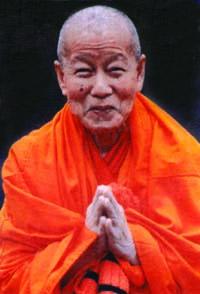 Two positive initiatives grounded in Buddhism and peace building have emphasized the resolution of political conflict. Buddhists were active in resolving the 1991 political conflict and the 1997 attempt at a political coup in Cambodia. The presence of the Samdech Sangharaja (National Head of the Monastic Sangha) was critical to the peaceful closure of both conflict situations. His involvement was initiated by a Buddhist organization called Santi Sena. Two positive initiatives grounded in Buddhism and peace building have emphasized the resolution of political conflict. Buddhists were active in resolving the 1991 political conflict and the 1997 attempt at a political coup in Cambodia. The presence of the Samdech Sangharaja (National Head of the Monastic Sangha) was critical to the peaceful closure of both conflict situations. His involvement was initiated by a Buddhist organization called Santi Sena.
Ven. Maha Ghosananda has led Cambodians to a joint declaration of peace among religions coordinated by the United Nations Educational, Scientific and Cultural Organization (UNESCO). UNESCO has assumed an important role in encouraging the government, NGOs, and other international communities to develop a culture of peace. Supporting activities have occurred through formal and informational education, livelihood projects, sports, environment projects, etc.
In 2000, UNESCO chose Cambodia as one of 5 priority countries to assist in developing a culture of peace. The willingness of the government and political parties to engage in peace promotion has been best demonstrated in active campaigns for weapons collection and destruction and in the absence of armed conflict. The words of peace are now present on banners at most important events.
UNESCO has since launched a pilot project in establishing a culture of peace at a former Khmer Rouge stronghold, Phnom Vorlli, in Kompot province. The program is managed by local Buddhists in cooperation with the local authorities. Within this project, the culture of peace or non-violence has been integrated with welfare, education, livelihoods, community re-building and other development activities. Education materials were developed by the organization, but implemented by the local authorities beginning first with the education of children and mothers and eventually involving the men in the community. Local UNESCO staff believe that basic needs are a leading goal in achieving a culture of peace. For example:
=> share their concerns or basic needs => build trust => integrating common goals |
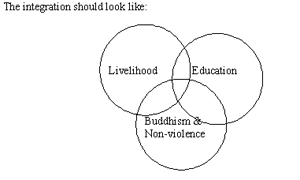
Within this matrix, we should note that the Abhidhamma said that life can be maintained first when a person has enough food to eat. Then, he/she can have no worries and become concerned with other things such as peace, etc. For educators, the balance among livelihood, Dhamma and the culture of peace is relatively simple, at least according to UNESCO staff members who emphasize the need to "stop fighting and start debating".
In the future UNESCO will replicate this project in another priority area, possibly cooperating with the Ministry of Culture and Religions to increase the culture of peace through temples. As the traditional focal point of communities, temples provide an ideal locus for engaging Dhamma in social development.
The Ministry of Culture and Religions is committed to the rebuilding of Buddhism nationwide. It has encouraged every temple in Cambodia to support the strengthened presence of Buddhism and development by establishing temple development associations. In 2002, the Ministry announced that the monks of every temple should play more important roles in helping society to rebuild the Khmer spirit, or social morality, and to participate in environmental preservation and protection. Now, at many primary schools, children participate in a chanting program before taking class, and key governmental and NGO employees are trained in the Buddha's 4 Noble Truths and development.
The National Vipassana Center is increasing its emphasis on Buddhist education and has developed formal structure of Buddhist education which incorporates national and district levels. Thousands of participants are studying and practicing vipassana, and though most of the participants are elderly, there is an increasing number of professionals and students. The center is encouraging highly developed Buddhists to follow the 4 Noble Truths and 3 Trainings (tri-sikkha) and has encouraged beginner Buddhists to practice the meditation methods that can help them to refresh their minds and to develop a greater awareness for their lives and work. To increase the number of participants, they have also begun to offer certificates to participants who complete their training.
Several Buddhist based or monk led organizations actively operate in Cambodia, such as Buddhism for Development (BFD), the Buddhist Fund, SantiSena, Buddhism for Kompong Thom Development (BFDK), and Community Friends for Rural Development (RFCD). BFD, SantiSena, and the Buddhist Fund are notably active in peace making and in activities related to livelihood. More Buddhist organizations exist, but have yet to establish development programs in the country. Many NGOs also provide development activities in a variety of areas such as livelihood, environment, and literacy but have yet to integrate peacemaking as a focus.
BFD believes that the Buddhism philosophy is to help humans based on the Buddha's well-known advice, "Venerables, please go to villages and communities and cities to express the Darma to a great deal of people for their advantage and for the peace (sokha) of many lives, including humans and devas". The key Dhamma used in its community development are physical development (kaya bhavana), moral development (sila bhavana), spiritual development (citta bhavana), and wisdom or intellectual development (panna bhavana). Some BFD staff members are monks, and go out from the temple with the intention of saving lives.
SantiSena is another example of a Buddhist organization that promotes peace and livelihood. Santi means peace and sena means servant, so the monks of SantiSena are seen as peace workers. SantiSena works closely with Maha Ghosananda. SantiSena is involved with other peace promoters and with the use of influential monk roles to help solve national political conflicts. BFDK, meanwhile, focuses its work on the environment and education using practices and beliefs similar to the BFD. The Buddhist Fund concentrates its activities on "The Middle Path" in making peace. It uses a book which was written by Maha Ghosananda, Step-By-Step, as an organizational guide.
Other NGOs promoting peace in Cambodia are Silaka and Star-Kampuchea. These two organizations participate in the peace walk (Dhammayietra) created by Maha Ghosananda. This peace walk has been cooperatively sponsored by several NGOs, including several Christian NGOs. The Weapons Reduction Group actively works with the government, NGOs and community development actors to integrate weapons reduction into community development and to date has collected and destroyed thousands of weapons. The Cambodian Development Research Institution (CDRI) published the Buddha's experiences on peaceful conflict resolution for peace makers and problem solvers in Cambodia. Human rights organizations educate and monitor human rights in Cambodia using Buddhist concepts, especially the five precepts. The Active and Non-Violence Working Group (ANVWG), supported by two international NGOs, encourages grass-root organizations in 15 provinces to experience and solve problems through non-violent methods.
Limitations and Recommendations for Buddhism and Peacemaking
Buddhism has been instrumental in promoting nonviolent responses to violent unrest, and the Dhamma has proven to be powerful in its contribution to individual and community peace. However, the potential of Buddhism as a consistent and meaningful service to peace in Cambodia is limited in the following ways:
* There is a lack of influential and active monk leaders to encourage and direct Buddhist education. One of the Supreme Patriarchs is seen by the public to be working for a political party and has a low level of Buddhist education. Key monk leaders should relearn Buddhist philosophy and the Buddha's life, play a leading role in education, and develop a long term and measurable peace making plan to support their own spiritual development.
* Despite the positive efforts of many temples and monks in peace activities, the majority have been isolated from building peace in Cambodia. For example, domestic violence and spiritual education programs are often implemented by non-monks or people without knowledge of Buddhism. Financial and technical support is given to development projects that have not recognized the importance of spiritual education. It is recommended that NGOs, the government, and supporting agencies cooperate more actively with temples in implementing development activities, especially spiritual development. Monks have powerful techniques to produce peace, and they are located everywhere in Cambodia. When trained in the right Dhamma tools, they can be of significant service in the making of peace. It is also recommended that Buddhist funds be used to contribute to public needs and community support services in addition to temple construction.
* Some monks are interested in social activism and in conflict resolution, but are not allowed to do so because of political pressure. It should be an option to introduce Buddhist philosophy to influential politicians in both direct and indirect ways (publications or media), assisting them to recognize the potential of involving monks on behalf of Cambodia.
* Most monks traditionally remain in the temples, but could be useful to those Cambodians in need of mental or spiritual help. Buddhism was established to minimize suffering, and the Dhamma is intended to move lives from suffering to peace - the role of the pabbaja (practitioner) is to help him/herself, then others. Thus the Buddha taught us to be active, do what we can do and go to the communities to save lives with maha karuna and metta. Buddhism is the bed or nursery of peace and good actions, but now it has been terribly damaged. An internal and external network of sangha in Cambodia could establish a network to regularly share Dhamma tools or Buddhism and peace development experiences.
Dhamma Teachings with Relevance to Political Violence in Cambodia
As the Buddha said to Ananda, "People who are in hell are like the soil under my feet, and the people who are enlightened are like the dust on my feet". Not many currently practice the five Buddhist precepts (sila), which are the foundation of peace and human rights. However, suffering and violence can be solved by the tri-sikkha (the three trainings of precepts - sila, meditation - samadhi, and wisdom - panna). The tri-sikkha is an effective tool to achieve the Noble Eightfold Path, and when we succeed in these, everyone will have great compassion (maha koruna) and great love (maha metta). Finally, we will live in peace, especially when, as stated by Maha Ghosananda, "We work for peace step-by-step." So we should build peace for others through a gradual, step-by-step activism and developing inner peace as seamlessly as breathing or eating meals.
To build peace, we need to educate people about maha karuna and metta. To build maha metta we should follow two ways: 1) encourage interested people to practice the tri-sikkha, and 2) provide opportunities to those who lack metta to learn about dukkha (suffering and the results violence) and samudaya (the roots causes of suffering). People who are wise or respected leaders and follow the tri-sikkha can be influenced to educate and demonstrate these principles using clear goals and desired outcomes. The Buddha said, "A wise person leads to peace".
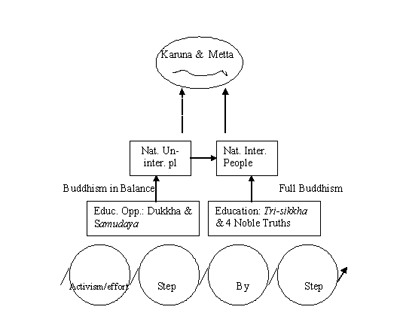
Once day, the naturally interested and naturally uninterested people may join together in the tri-sikkha when their right understandings have developed.
Conclusion:
There have been some successful efforts to build a culture of peace in Cambodia by Khmer peace activists, the government, NGOs, and the international community. Non-violence has been included in such development activities and sectors, such as peace walks, sports, literacy, formal education, advocacy, livelihoods, etc. We have seen weapon reduction, weapon laws and peace agreements. National Buddhist structures have become more active in spiritual development in Cambodia. A few Buddhist organizations now work for the communities in their practice Buddhism as a means to save lives from suffering.
However, peace initiatives have been limited by the lack of strong education methods, the lack of collaboration among peace promotion activities, and the inability of peace promoters to fully use Dhamma tools in development. Not many Buddhist institutions are able to understand or translate a vision of Buddhism into practice as it applies to social and economic development, and most Buddhists are not active at the community level. Thus, there is no clear movement to build spiritual peace in Cambodia. A long-term spiritual education plan should be scientifically implemented with cooperation among all those committed to development and peace. It should assist monks to become seriously involved in violence reduction, and non-religious organizations to understand how to support traditional practices in development. With the assistance of respected and wise leaders to educate and demonstrate the tri-sikkha, karuna and metta through activism/right effort, we should be able to build peace in society. In order to have a strong spiritual peace building movement, we should bring together all peace building institutions and religious activists to work in sharing knowledge and experience as well as tools and the way to conduct regular education regularly and spiritual peace building activities. Buddhist organizations or networks should be led by well educated Buddhists who have a high level of compassion and are willing to work for sentient beings and social change like Maha Ghosananda - otherwise, it will be ineffective and less influential.
Ubasak Ros Sotha was born in Phnom Del Village, Kompong Cham province, Cambodia. He has been working for 9 years in building the capacity of civil society organizations, including some Buddhist organizations at the provincial level. Now he works for an INGO, Pact, building the capacity of Cambodian advocates. In addition to this, he is working voluntarily for 4 different Buddhist organizations: Buddhism for Progressive Society (BPS); Buddhism for Development of Kompong Thom Province (BFDK); Rural Friends for Community Development (RFCD) and Help Old Aged and the Most Vulnerable (HOM).
------------------------------------------------------------------------------
Preah Vinakyak Tripidaka, page 66, no. (32). In a history of the Buddha written by Toyohara Daijo, he describes the Buddha's daily activities, saying that during the 3-month rainy season, the Buddha meditated. Besides this, he went from city to city and village to village without wearing shoes, nor riding anything at all, in order to explain the Dhamma to people.
VivithakDarmaSangahak, page 131, edited by M. U Kao Sovann, 1970
The Buddha also said that people who ha ve just a bit of dust in their eyes (i.e kilesa - greed, anger and ignorance) have some capability to understand the Dhamma and become enlightened. Thus, it would be a great shame if their lives become spent without coming in contact with the Dhamma 。
|




 Report & Article