|
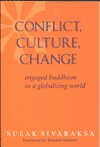 'The price of imperialistic policies which uphold structural violence is terrorism ', writes social critic Sulak Sivaraksa in a new collection of essays in which he expands on his belief that Buddhism speaks to the most urgent problems of today's world 'The price of imperialistic policies which uphold structural violence is terrorism ', writes social critic Sulak Sivaraksa in a new collection of essays in which he expands on his belief that Buddhism speaks to the most urgent problems of today's world
Sulak Sivaraksa turned 71 on March 26. His latest book was recently published in Boston in time for his birthday celebration in Uthai Thani, Conflict, Culture, Change addresses many themes familiar to Sulak's followers, readers and critics. In a foreword, Don Swearer, director of [he Center for the Study of World Religions at Harvard Divinity School, observes that Sulak has many faces and that the new book "reveals many facets of a modern traditionalist caught in the belly of a paradox".
Sulak is a larger-than-life figure in our society. He was nominated tor the Nobel Peace Prize; he faced down a charge of lese majeste filed against him in Thailand; he received a Sight Livelihood Award from Sweden and the Gandhi Millennium Award. Thich Nhat Hanh, the Vietnamese Buddhist leader and poet, described Sulak as a bodhisattva who devotes all of his energies to helping others.
[Bodhisattva (Sanskrit) or bodhisatta (Pali):
1. "A being [striving] for Awakening"; the term used to describe the Buddha before he actually became me Buddha, from his first aspiration to Buddhahood until the lime of his full Awakening.
2. Often used in Mabayana Buddhism to refer to Enlightened Ones who, because of their great compassion, decide to defer nirvana in order to return to help people in this world.)
Sulak is deeply rooted in Thai culture and tradition yet his networking surpasses even that of many great contemporary statesmen. He is the epitome of a citizen of the world.
He is also a difficult person to sum up in a nutshell- The range of his interests, thought and commitments is breathtaking. He is, indeed, a paradox.
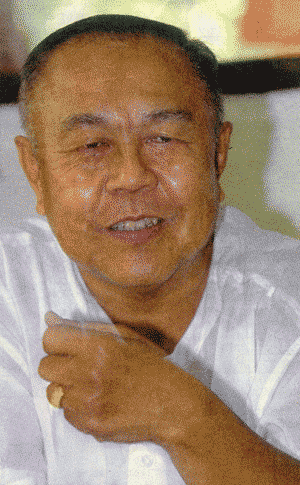 Sulak is steeped in Thai Buddhist culture. He prefers to carry a Victorian gentleman's walking stick rather than a mobile phone or laptop. He dons traditional peasant garb to underscore his alienation from modern culture and technology and advocates a traditional, rural-centred definition of Thai culture. Sulak is steeped in Thai Buddhist culture. He prefers to carry a Victorian gentleman's walking stick rather than a mobile phone or laptop. He dons traditional peasant garb to underscore his alienation from modern culture and technology and advocates a traditional, rural-centred definition of Thai culture.
Yet he is one of the world's leading jet-setters, clocking up more frequent-flyer miles than the CEOs of many multinationals. With his queer pyjamas and antique Burmese army walking stick, he has become a familiar sight at airports around the world. He is at the cutting edge of the new global citizenry.
The wide-ranging essays in Conflict. Culture, Change offers a glimpse of the breadth and coherence of his worldview. Here, he wears many hats: Sulak the Buddhist leader: Sulak the activist; Sulak the historian; Sulak the publisher: and Sulak the social critic. Because of his many conflicting roles he often comes across as a man of contradictions. But he is far from being a confused person. His different roles tend to cohere around a few basic values and syncretic philosophical concepts. Sulak loves good French wine. Yet his outlook on ! ife is deeply informed by Thai Buddhist values. "Buddhist teaching is the core that permeates all my activities," he writes; and, elsewhere; "violence has its origins in the three poisons of greed, haired and ignorance".
Born in 1933, a year after the fall of Siam's absolute monarchy, Sulak attended temple school as a boy, later attending university in England where he studied law and was called to the Bar-In his formative years he fell under the influence of Mahatma Gandhi and Quakerism. Subsequently, his basic Buddhist precepts prescribing respect for the life of all sentient beings was enriched by the Gandhian philosophy of non-violence and by Quaker pacifism. "The Quakers, officially known as the Religious Society of Friends, have been a constant source of inspiration and support in my life and my work as an engaged Buddhist," he writes.
For Sulak, Buddhism and the philosophy of non-violence have a mutual resonance- In Chapter 2 of Conflict, Culture, Change. "A Buddhist Perspective on Non-Violence", he pays tribute to Gandhi and to Peace Brigades International, which was founded by his old Quaker friend, George Willoughby, among others.
The philosophy of non-violence holds that when conflicts arise, opposing parties tend to resort to violence to resolve them; but that that violence only breeds further violence,
"Justifications of violence in terms of moral arguments like [it's] just war or [a] crusade degenerate into excuses for atrocities in the name of pious principles," Sulak observes. The committing of atrocities merely serves to fuel anger and provoke more violent reactions. Only the practice of nonviolence can reduce conflict.
Attempting to resolve disputes by violent means is, invariably, a recipe for tragedy, grief and regret. Advocates maintain that non-violence can reduce conflict and has been shown to work effectively in peace-making and peace-building efforts.
Sulak recounts the use of non-violent methods to build trust during the Arab-Israeli conflict.
"Tragic consequences resulting from prolonged violence often prompt warring parties to seek reconciliation," he observes- Non-violent intervention can pave the way towards reconciliation; by reducing conflict, it allows deep wounds 10 heal and creates space fora spirit of cooperation and forgiveness to develop. Sulak compares two prominent cases of reconciliation: the formation of the Truth and Reconciliation Commission in South Africa and the struggle by peasants displaced, or otherwise affected, by the construction of the Pak Moon Dam to have their means of earning a living restored 10 them.
Sulak also employs a Marxist critique of capitalism and the global economy to refine and extend the definition of violence. Lately, many of his contemporaries have remarked that he is a Buddhist who sounds like a Marxist, or vice versa. According to Sulak, peace is not just the absence of war. He introduces the idea of "structural violence", A global economic system which starves the majority in order to enrich a few is inherently violent, he asserts. It is a structural arrangement which perpetrates great injustice. The will to impose injustice on fellow human beings constitutes violence. It is structural violence -
"Violence breeds violence," he writes, The price of imperialistic policies which uphold structural violence is terrorism. IT) the wake of the September 11 terrorist strike on the World Trade Center in New York many main sire am Western scholars and the media have attempted to demonise Islam. But Sulak exonerates Islam and blames US imperialistic policies and practices for causing the 9/11 attacks. To escape the cycle of violence the US must shun violence and pursue policies grounded in "non-harming" as opposed to continuing its support for structural violence.
Sulak believes that Buddhism speaks to the most urgent problems of today's world. The Dalai Lama calls for tempering capitalist competition with Buddhist compassion to create a more humane world. The UN's call for sustainable development echoes the Buddhist epistemological concept of "interdependent co-arising" and the belief in the interconnectedness of people and nature. Sulak devotes a whole chapter, "Buddhism and Environmental ism", to discussing Buddhist teachings on nature, the sanctity of forests, water sources and the interdependence of all living things.
The highlight of the book is a substantive chapter entitled "From the Lotus Flower to the Devil's Discus: How Siam became Thailand". In it Sulak demonstrates his prowess as a historian as he recounts certain fateful events of the mid-20th century
He decries the name change from " Siam" to " Thailand" on June 24, 1939, as an attempt to claim ownership of this country for ethnic Thais at the expense of the Mon, Lao, Cambodian, Shan, Malay, hill-tribe and other ethnic minorities in our population. At a lecture he delivered at the Siam Society earlier this year, Sulak traced [he problem of separatist violence in the South back to a nationalist agenda which sought to establish the primacy of Thais over other ethnic groups- Modern Thai nationalism which emphasises the primacy of the former and its right to dominate other ethnic groups in the polity has alienated minorities, especially the Malay Muslims in the southern provinces. Sulak continues to campaign to have the Kingdom's name changed back to " Siam".
Bangkokpost , Saturday april 9, 2005
Review by Jeffery SNG
|




 Report & Article