|
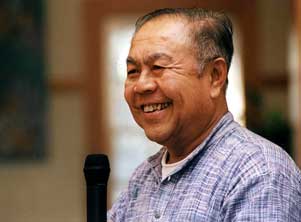
Pracha Hutanuwatr, Thai activist and intellectual, is a former Buddhist monk with a socialist background. He has worked under the guidance of Buddhadasa Bhikku, a renowned, Buddhist monk and philosopher who developed the concept of Dhammic Socialism; and Sulak Sivaraksa, an influential, independent thinker. In 1988 Sulak and Pracha founded the International Network of Engaged Buddhists.
Pracha's present positions include Director of Wongsanit Ashram and Director of Spirit in Education Movement, an NGO organising Grassroots Leadership Training in South East Asia . He has published several major books in Thai. Recently he and Ramu Mannivan published (in English): Asian Futures: Dialogue for Change, which contained intensive interviews with 14 prominent Asian thinkers.
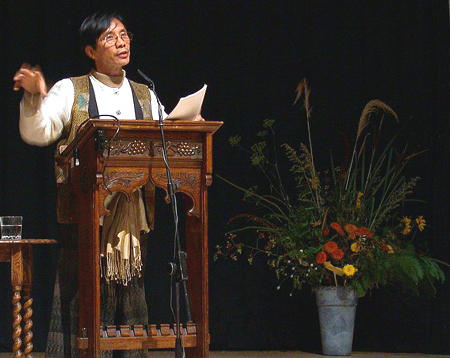
Pracha is a gentle, loving, humble being of truth and wisdom - a man who consistently walks his talk. He is a well-respected, well-loved part-time resident of the Findhorn community. Today he spoke eloquently to a captive audience on the topic of Asian Worldviews and the Ecovillage Movement. Asia has been working for a sustainable future for decades. As an Asian, Pracha feels very inspired by the ecovillage movement in the west. Over the past few years, Pracha has been sending friends from both Burma and Thailand to participate in the Ecovillage Training programme at the Findhorn Foundation. Participants from this part of the world are always surprised to learn, during the training, that their country's ecological foot print is comparatively very slight as they use much fewer natural resources for day to day living. 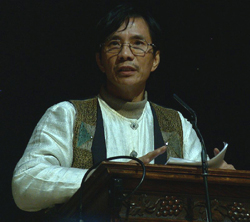 Using a broad definition of ecovillage, Pracha shared that more than half of Asians are still living in ecovillages which are naturally ecological in the traditional sense. They are now under big threat and albeit are not perfect. The threat comes from the pressure to modernise and globalise over the last 100 years. They are being brainwashed to follow the west and this modern education has caused them to lose confidence in their values and culture, and adopt an unnatural catch up mentality. And this is the mentality Pracha's movement tries to work with. By the time they gained independence their elites came to feel they belonged to societies that were intrinsically inferior to the west. This inferiority spread to the masses through education and mass media. The dilemma is that this alienating and uprooting process is needed to fuel consumerism and sustains the process of ongoing globalisation. Using a broad definition of ecovillage, Pracha shared that more than half of Asians are still living in ecovillages which are naturally ecological in the traditional sense. They are now under big threat and albeit are not perfect. The threat comes from the pressure to modernise and globalise over the last 100 years. They are being brainwashed to follow the west and this modern education has caused them to lose confidence in their values and culture, and adopt an unnatural catch up mentality. And this is the mentality Pracha's movement tries to work with. By the time they gained independence their elites came to feel they belonged to societies that were intrinsically inferior to the west. This inferiority spread to the masses through education and mass media. The dilemma is that this alienating and uprooting process is needed to fuel consumerism and sustains the process of ongoing globalisation.
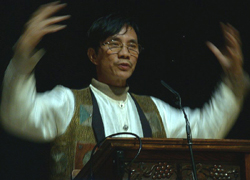 Happily, there is a spiritual resurgence in Asia - it is being recognised that simple village life is not backward. There is wisdom in social, ecological, economic and spiritual systems that defines good life and good society by Asia 's own terms. This process requires re-examining most of the European enlightenment world view - the basis for Asian modernisation. Although the Greens in the west are doing the same, an alternative world view born of the two inquiries remains to be seen. Happily, there is a spiritual resurgence in Asia - it is being recognised that simple village life is not backward. There is wisdom in social, ecological, economic and spiritual systems that defines good life and good society by Asia 's own terms. This process requires re-examining most of the European enlightenment world view - the basis for Asian modernisation. Although the Greens in the west are doing the same, an alternative world view born of the two inquiries remains to be seen.
Ghandi saw modern civilisation as soul-destroying and referred to it a kaliyga (black age), engendering:
* economic disparity and exploitation of the poor * population increase * direct violence of war and armed conflicts * ecological degradation * abuse or rejection of religion.
Pracha began to explain the downward spiral: modern science and industrialisation helps people produce more than is required, then there is a growth of surplus production and strategies to dispose of surplus production are needed. The principles of supply conditioning demand are replacing the principles of demand and supply. This is founded on two negative human emotions: greed and hatred. A sense of craving for more and more became acceptable and encouraged, followed by a period of indoctrination of the younger generations. The traditional systems of human co-operation were replaced by competition that brought about human selfishness and destroyed the human spiritual, moral, and ethical qualities. This is the growth of the dark age, looking from an economic point of view. However, from the Asian world view, the root causes of this dark age can be traced back to other basic concepts dominating our modern thoughts.
The most crucial modern idea is the idea of progress marked by:
* change for the sake of change
* lost ability to appreciate beingness
* an inability to give value to ordinary people and ordinary life
* the constant desire to improve things - make them bigger, faster, better - and to have more.
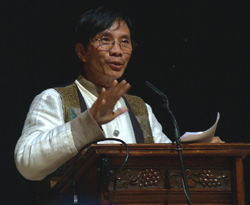 Traditions are no longer relevant. Wherever modern civilisation touches down, people are uprooted. Spiritual traditions in Asia have a more cyclical notion of historical development - the future is not necessarily better than the present or past - good society can happen at any time present, past or future, depending on the quality of human beings who live in it at that moment. Traditions are no longer relevant. Wherever modern civilisation touches down, people are uprooted. Spiritual traditions in Asia have a more cyclical notion of historical development - the future is not necessarily better than the present or past - good society can happen at any time present, past or future, depending on the quality of human beings who live in it at that moment.
If both the elite and the people are corrupt/irresponsible, then society at that time will decline. This is why in Asia they emphasise critically respecting traditions, ancestor worship, respecting elders, valuing indigenous wisdom, and contentment. During a period of American domination in Viet Nam , they were asked to stop teaching contentment because then the people would no longer want American development.
In the Asian world view, human beings are important as both individuals and a collective, but not in an anthropocentric way. Human beings are co-creators and an integral part of the cosmic process. In an important Buddhist sutra the behaviour of human beings affects natural phenomena. If the elite and the people don't act according to the dharma, the orbit of the moon, the sun, and stellar systems will fluctuate and the natural ecosystems will be disturbed by the ambitions and greed of people.
Most Asian spiritual traditions see human beings as part of, rather than master of, nature. The forest is the centre of civilisation rather than the city. In this kind of civilisation, the living source of wisdom comes from spiritual practitioners who spend time in nature, especially in forests, to meditate and train themselves so that they achieve a higher level of maturity and human potential. Achieving the highest human potential goes together with the simplest way of living, very close to nature.
In terms of community, the individual is important, but not in an individualistic sense of being selfish and self-centred. All traditions emphasise training to refine the individual to be a healthy and creative part of a community. The aspect of non-self in Buddhism does not mean to do away with the individual as exemplified in the life of the disciples of the Buddha. They were selfless, enlightened individuals with uniqueness of their own individuality motivated by pure wisdom and compassion.
The cultivation of the individual is to develop the positive side of wisdom, compassion, generosity, and curb the negative side of greed, hatred and self-centredness. The definition of who you are is not only you as an individual, but you in relationship with the community to which you belong. At the same time, there is an awareness that an over-emphasis on the community or collective can be harmful as it not only limits the full flourishing of individuals, but also can be destructive to bigger collectives such as the Japanese in WW2 where individuals were asked to sacrifice to the collective to harm others.
There are also other oppressive side of over-emphasis on the collective side of community, so the balance is important. We also have to be aware that both individuals and the collective can do harm or good, depending on whether the wholesome or unwholesome sides of human nature are cultivated and activated.
Pracha then turned our attention to science and knowledge. In the modern world there is a supremacy of scientific knowledge but it considers nature as a subject of exploitation. Science does not understand the human mind. The basic objective of modern science is creation of power and wealth. The three previous aspects of science make it a wrong kind of knowledge - it is not neutral, it is more destructive to humans and nature. Science could and should be guided by a broader spiritual vision.
Over using rationality makes human beings unhealthy in relation to themselves, other human beings, and nature. Healthy relations are based on wisdom, not rationality. Knowledge of relationship evolves over time with common sense and cultural sense.
Community develops knowledge in a social rather than personal way. Communities are living knowledge systems. This does not mean that scientific knowledge and rationality do not have a place in Asian society, rather they have to stop dominating other forms of knowledge. Pracha feels they need to acknowledge indigenous and spiritual wisdom, and that they can gain knowledge and information from science, but not wisdom.
In the Asian world view, the human being is basically a spiritual being. Spirituality is not something up there in the sky or in the church, but interwoven into our daily life which is a training ground for developing higher human potential of love, generosity and wisdom. In our daily life contentment is the key and prosperity does not mean abundance in terms of material wellbeing, but richness in human interaction and the joy of being close to nature as well as connected with the cosmic spiritual forces of love and joy.
Spirituality and science belong to different categories of knowledge and they do not necessarily contradict each other. They answer different kinds of questions. For Asians, science cannot answer the question of the purpose of life - that is why scientific knowledge needs to be guided by spiritual wisdom - otherwise, the power of scientific knowledge can be abused and become very dangerous.
Before the colonisation period, Pracha told us, Asia had diverse forms of states, hundreds of forms. After the colonisation era, there is only the nation-state. This form of nation-state is more harmful than good. Either the capitalist or communist form, or mixture of both. All nation-states in Asia see people as subjects, not as participants, in the decision making process. They are also afraid of people. So standing armies, police forces, and paramilitary organisations are used to subjugate people.
Modern statecraft is completely controlled by the power of money. The fundamental reality is that ordinary people have no voice. Unlike other Asian social reformers, Gandhi did not look at the state as a tool for social change. His vision for a good society did not comprise of a good state, rather a network of self-reliant village republics.
Many thinkers believe that the democratic culture developed over centuries in the agricultural villages of Asia . This is a grassroots kind of democracy that has been practised among the people for millennia. It is a very important institution that needs to be preserved, cultivated, and strengthened for the future needs of Asia , beyond the notion of the nation-state.
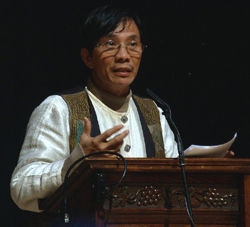 Pracha concluded that the ecovillage movement in the Asian context consists of two dimensions. Firstly, to preserve and rejuvenate traditional villages that are still ecovillages. In practice, this is still more than half of Asia . Secondly, to recreate alternative communities for those uprooted from their traditional villages and integrate the idea of ecovillage into urban settings. In both dimensions, it is extremely important to deconstruct the wrong world views that dominate Asia at the moment and replace them with the alternative ones, namely: Pracha concluded that the ecovillage movement in the Asian context consists of two dimensions. Firstly, to preserve and rejuvenate traditional villages that are still ecovillages. In practice, this is still more than half of Asia . Secondly, to recreate alternative communities for those uprooted from their traditional villages and integrate the idea of ecovillage into urban settings. In both dimensions, it is extremely important to deconstruct the wrong world views that dominate Asia at the moment and replace them with the alternative ones, namely:
* Reject the ideas of linear progress and look into the values of traditional culture and practice. This means that a simple life, close to nature, spending a lot of time in idle meditation is not inferior to a busy life in New York city trying to make big money, and achieve power and fame. We don't have to 'catch up' with western consumeristic lifestyle.
* Reject the view that humans should dominate nature and use it for human sake. Nature needs to be respected and we need to co-exist with nature. The symbol of civilisation is a simple meditation hut in the forest, not a scientific laboratory in the city.
* Human faculties allow us to know very little about the world. Scientific inquiry cannot answer important questions of life, society and nature. Indigenous wisdom and contemplative spiritual tradition give us more answers to the important dilemmas of our time.
* Extreme individualism should be rejected. The individual is important, but has to be refined and defined in the context of community, nature, and the cosmos. The full potential of individuality does not need to be individualistic. On the contrary, the less selfish one is, the more opportunity for authentic flourishing of the individual.
* Debates on a vision for a good society should be focussed on how villages can work towards self-reliance and sustainability, not on how to organise governments and state structures. Energy of activists for change should be put into empowering villagers, rather than creating good governance.
At least in Asia , without putting the ecovillage movement in the abovementioned context, it will not bring about real hope for a sustainable future on a big enough scale. The danger of working outside this context could be pockets of middle class escapist pseudo communities living together in an alternative kind of consumerism, where it is still consumerism none-the-less.
From: http://www.findhorn.org/content/ecovillage/archive/000526.php |




 Report & Article