OBITUARY Samdech Preah Maha Ghosananda, Buddhist Peacemaker and Patriarch March 13, 2007
Contact: Pich Chhoeun
01 (401) 499-7961
For Immediate Distribution
Samdech Preah Maha Ghosananda, a preeminent Buddhist leader of the second half of the 20th century, died early on March 12 in Northampton MA, USA.
One of a few senior monks to survive the Killing Fields (the period of Cambodian history ranging from 1975 -1979 yielding one of the world's most brutal civil wars), Ghosananda emerged as a legendary exemplar for peace and forgiveness. Having lost his entire family to the genocide, Ghosananda served as both a pastoral force for survivors' spiritual recovery and as an activist for reconciliation between opposing political factions.
Serving as a Supreme Patriarch of Cambodian Buddhism and a leading Buddhist scholar fluent in some ten languages, Ghosananda is known for his remarkably simple ways. He is honored as a scholar monk, a meditation master, and a peace advocate, having studied with renowned exemplars in all three traditions.
For his contributions to world peace and reconciliation within Cambodian communities throughout the world, Ghosananda became a recipient of the Niwano Peace Prize (Japan, 1998) and the Rafto human rights award (Norway, 1992). He was nominated six times for the Nobel Peace Prize. Most famous for leading the Dhammayietra peace walks through Cambodia, Ghosananda was equally an international figure, representing Buddhism and Cambodia with world religious leaders. He was the founder of the first Cambodian temples in North America and Europe, a critical step for Cambodian immigrants in their newfound countries.
While some aspects of the monk's past remain unclear, the broad outlines are not. Ghosananda was born in Takeo Province, Cambodia in 1924. He was ordained at a young age, and became a student of the former patriarch Samdech Prah Sangha Raja Chuon Noth. Ghosananda received a doctorate in Buddhist Studies from Wat Unalom, and then taught Buddhist studies at Nalanda University. There in India on the neighboring sacred mountain of Rajgir, Ghosananda studied with Nichidatsu Fujii, founder of the Japanese Buddhist order Nipponzan Myohoji. Fujii was a devotee of non-violence, having lived with Mahatma Gandhi at his ashram and deeply supporting Gandhi's non-violent independence movement. Later, Ghosananda studied with the great Thai Buddhist social thinker Bikkhu Buddhadhassa and the meditation master Achan Dhammadaro. Ghosananda remained on retreat and studying meditation for the better half of a decade, though the exact years are not known. When asked what he did when there was nothing to do, he answered prophetically that he was meditating to be peaceful, so he could give this gift to others.
With the end of the Cambodian civil war and the formation of Cambodian refugee camps on the Thai boarder, Ghosananda was able to begin his active peace-work in the form of Buddhist ministry and restoration. He established simple hut-temples in all of the refugee camps, and taught meditation and the need for inner peace. This work, with the help of a band of community oriented activists, contributed to the launch of many cultural and humanitarian programs, and to the formation of peace walks that the monk led throughout his native country. The Dhammayietra peace walks, and many social programs, continue within Cambodia today. These massive activities, some of the largest peace actions seen in Southeast Asia, have been hailed as a positive way for the pubic to engage the government and civil society in the healing process, and a move toward more representative form of government.
In parallel with early local efforts, Ghosananda also met with world religious and political leaders, communicating a need for global support for the Cambodian humanitarian crisis. The monk's strong presence at UN-brokered peace talks reminded participants of the Buddhist teaching, ‘Hatred can never be appeased by hatred...it can only be appeased by love.'
Ghosananda was critiqued by some members of the sangha as being too much an activist, and by some activists for his quiet ways. Known for selfless service, traditional knowledge, and as an accomplished mediator, Ghosananda had his own clear sense of balance: to walk with peace, inviting others to join him. He often proclaimed, ‘We walk slowly...step by step...each step is a prayer...each step builds a bridge.'
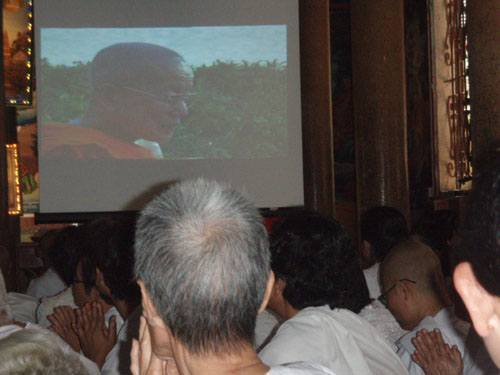
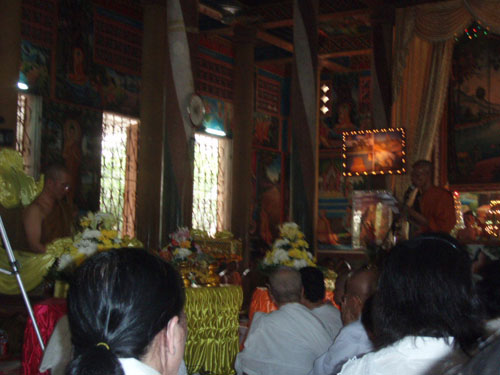
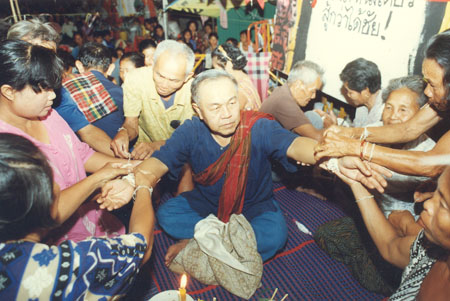
On March 17-18, 2007 the ordained and lay disciples, people in civil movement and general public attended the ceremony at the 7th day after the demise of Samdech Preah Maha Ghosananda at Sampeov Meas pagoda, Phnom Penh, Cambodia (photos from our friend Him Yun from Khmer Youth Association)




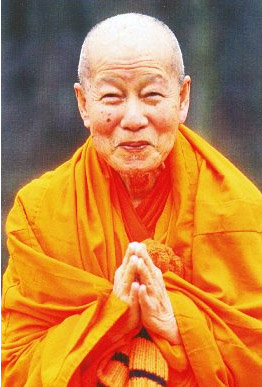 One of a few senior monks to survive the Killing Fields (the period of Cambodian history ranging from 1975 -1979 yielding one of the world's most brutal civil wars), Ghosananda emerged as a legendary exemplar for peace and forgiveness. Having lost his entire family to the genocide, Ghosananda served as both a pastoral force for survivors' spiritual recovery and as an activist for reconciliation between opposing political factions.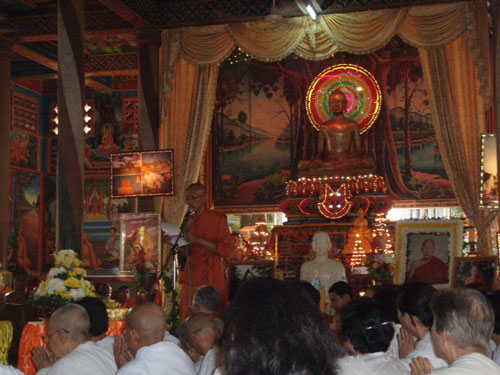
 Report & Article