|
The King and the game of generals
Ignoable intentions
David Fullbrook examines Thailand's coup-battered
body politic - and finds that time may be running out
for an imminent return to full democracy
A fter a long losing streak, the establishment ended Thailand's democracy game last September with a clockwork coup, made palatable for many by the blessing of King Bhumibol Adulyadej. Now the hard part is making their idea of democracy stick amid skepticism, opposition and an elderly king.
Putting democracy to the sword made sense to conservatives lined up behind the throne because their archrival, ousted prime minister Thaksin Shinawatra, was certain to win yet another election set for last October.
"At the last hour, Thaksin was willing to stage a coup himself. In that sense, they had no choice. They felt Thaksin was a real threat to the monarchy and the old establishment, new money against old money," said Sulak Sivaraksa, a prominent social critic.
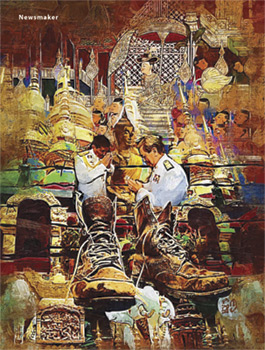
During his five years as premier, Thaksin had grown too big for his fine Italian shoes for the establishment's liking. Even the king's speeches chastised Thaksin, whose wealth - second only to that of the monarchy - bought immense power and sway. He touched the masses through simple, though dubious, policies putting money in their pockets and health care in their hands.
"It's a clash of elites within the Thai ruling class. Thaksin and the palace were competing for the same things politically and economically, particularly the hearts and minds of the masses," said Kevin Hewison, professor of Asian studies at the University of Carolina at Chapel Hill.
This conflict had been simmering since the rise of new money, much of it in the hands of Chinese-Thais like Thaksin, began in the 1960s amid surging exports. A new order was slowly emerging, loosely akin to the middle classes usurping the aristocracy's political power in 19th century Britain.
The coup has turned the clock back, giving conservatives time to boost their defenses. It was quick, certain and publicly somewhat distant from the king, protecting the strong aura he has skillfully forged around himself during his long reign. To many Thais - rich or poor, white-collar or blue-collar - he is more god than man, his reassuring image usually only a glance away. This position, however, means King Bhumibol can never be just a constitutional figurehead.
"He is supposed to be a constitutional monarch, he has the right to appoint the prime minister, who need not be the leader of the majority, the right not to agree with the prime minister in dissolving parliament - the king could have refused," said Sulak, who was charged for the third time in March with lèse majesté, the offence against the dignity of a reigning sovereign.
The coup leaders insist they acted without the king's knowledge. But not everybody is convinced. "I think the palace's fingerprints are all over this coup. How deeply the king was involved no one knows, but he could have reined in his privy councilors - he appoints them - if he wanted to," said Hewison.
The professor's claim is quite serious, but requests from ReviewAsia for comments on this article were rejected by both government and palace officials.
In the months leading up to September, signs and hints from Privy Council chief General Prem Tinsulanond, seen by many as the king's right-hand man, cleared the way for royalist military commanders led by General Surayud Chulanont, then a privy councilor and now premier, to act.
"The king has little direct influence and desires little on the junta. The king is very much retired anyway and somewhat feeble, so he has no choice but to leave it to Prem to deal with the details," said Paul Handley, author of a critical study of the Thai monarchy.
“It’s a clash of elites within the Thai ruling class. Thaksin and the palace were competing for the same things politically and economically, particularly the hearts and minds of the masses.”
Since the coup, the king has said little while the junta’s legitimacy has been crumbling. For all Thaksin’s alleged guilt, investigations have moved slowly. Surayud’s government has drifted from caretaker to policymaker, making controversial decisions, provoking public quarrels and resignations.
Meanwhile, the military is digging in, triggering fear. Its Internal Security Operations Command, formed to fight communism, now reigns supreme over all security agencies, including the police. An army officer is now deputy governor overseeing security in each province.
“Right now, it isn’t clear but there are signs the military wants to deepen their long-term power and control through revisions in the country’s administrative set-up and the constitution,” said Handley.
Concern is growing that the new constitution will deliver an ersatz democracy under the military’s thumb – a rerun of the 1980s when Prem ran the country seems on the cards. “I think the elite prefers a loyal prime minister and a parliament that doesn’t really matter very much. It doesn’t give the masses very much say,” said Hewison.
However, there are significant obstacles. “They made a great mistake in saying the constitution must be approved in a nationwide referendum. I’m afraid the people will reject it. I think we have moved a long way,” Sulak said.
Thailand’s civil society has flourished since the 1980s. Public consultation for the 1997 constitution was unprecedented. And people now expect more in the wake of Thaksin making good on populist policies. Worries about the next chapter of democracy are making for strange bedfellows. Some critics and supporters of Thaksin now find themselves on the same side, opposing the junta.
Alliances across political and social divides promise, if nothing else, a rough ride for the military’s plans. “I have a feeling things may break apart. They’re trying to manage a transition to a conservative Thai-style democracy. If they can’t sell it, I think they will use their military power to do it,” Hewison said.
For any arrangement lacking popular support to stick, it will depend on the aura of a beloved king whose health is not what it was. That may be the establishment’s undoing. As Duncan McCargo, an expert on Thai politics at Britain’s Leeds University, wrote in January: “No political order can safely invest its long-term stability in a single individual, however skilled and however wise.”
----------------------------------------
remarks : http://www.review-asia.com/index.php?option=com_content&task=view&id=23&Itemid=30
|




 Report & Article