|
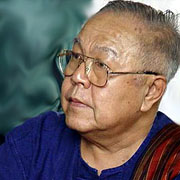
I met Sulak Sivaraksa for the first time in the early 1970s. Since we became friends mainly because of our religious and ideological understanding that transcended divisions, and our practice of solidarity in working for peace, Sulak invited me to present a paper in a Conference held in Bangkok, 10-13 February 2002 on "Peace and Insecurity in the 21st Century" in preparation for "Bandung II, 2005." Parts of the paper went into my summary of Memoir in Dialogue (Seoul-Hong Kong, 2002, pp.421-438). However, I am very happy to dedicate these reflections for the public celebration of Sulak's 70th birthday. May we be allowed to continue our dialogical pilgrimage towards new experimental dimensions of the fullness of life on this globe.
Summary
The end of the Cold war sees the US laying claim as the world's hegemonic successor. Transforming an ultra-conservative Christian value system into a strategy of a global "just war" against international terrorism, the US is attempting to implement a globalised hegemonic militarised system in which it seeks to manipulate the world community of nations and peoples.
This US position is contrary to what UNESCO and the UN General Assembly articulated in their 1998 declaration: "Towards a Culture of Peace." According to the inherent holistic vision, a culture of peace is the set of values, attitudes, traditions, modes of behaviour and ways of life. It reflects, inspires and seeks: (1) respect for life and all human rights; (2) rejection of violence in all its forms; (3) prevention of violent conflicts by tackling the root courses through dialogue and negotiation; (4) participatory and equitably meeting the (economic, cultural, environmental etc.) needs of present and future generations; (5) implementation of equal rights and opportunities for women and men; (6) recognition of the rights of everyone to freedom of expression, opinion and information; (7) devotion to principles of freedom, justice, tolerance, solidarity in difference, pluralism, cultural diversity, dialogue on all levels and sectors of individual and life in society. This vision encompasses the absence not only of war and open violence but at the same time also the absence of structural and indirect violence, at present manifested by the inequitable mono-polar distribution of power and resources.
What is to be nurtured is the existing multi-polar solidarity - a movement for life in peace which was born by the community of many peoples in all parts of the world and which will gain strength "from below." Asia has a long tradition and successful recent experiences of national peaceful conflict resolution carried out by various human rights, women rights and peace organisations. To deal with insecurity in the 21 st century, an Asia-wide strategy of solidarity for life will be supportive to prepare and create peace in the region, not only within communities, but also at the level of intra-Asian security politics.
1. Universality of Peace and the Doctrine of a "Just War"
The colossal loss of lives from the horrific terrorist attack of 11 September 2001 was most terrible and shocking. Regardless of the twisted rationale behind such an act, the result is an affront against humanity, human civilisation and human culture.
Unsurprisingly, the immediate reaction by the US to this horrific event was to declare the "first war of the new century." Washington quickly made it clear that it wanted to involve the entire world in its mission against the perpetrators. This retribution is well known in the Christian tradition since the days of Ambrose of Milan (339-97), who introduced the doctrine of a "Justified War" - coined by the Latin philosopher Cicero in 43 BCE - to Christian theology. It was the beginning of the re-alignment in the 4th century, which abandoned the universality of the Christian vision in favour of an alliance of the bishops with the Roman empire. While it did promote a vision of peace in the earthly city, pax romana, it was no more the Hebraic vision of an external global right order. It was the relative tranquillity of a very large but not worldwide empire that no longer called for loving the enemies of the empire or for empowering the underdogs of society.
The vision which promised that "peoples no longer will learn war" (Isaiah 2 and Micah 4) was lost. The apostles called it "good news" when they said that this schalom was to be fulfilled in Jesus. "Peace on earth" was the message promulgated at the eve of his birth (Luke 2.4). In the light of this beginning, God's children were called "peacemakers." Matt. 5 talks about a "higher righteousness" which reveals that it is by loving one's enemies that disciples are like their heavenly father. Ephesians 2.14 says that Christ is "our peace" because by reconciling Jew and gentile he has created "one new humanity." That expresses itself in the various interactions of the ministries in the body (Eph.4 and par.; Rom 12.1; 1.Cor.12) and in formal procedures of conflict resolution (Matt.18.15-17; 1.Cor.6.5-6). This original Christian vision of implementing peace in justice has never been extinguished totally and had advocates throughout the centuries.
But when the universality of this Christian vision was lost in general, the doctrine of "just war" was modified by Augustinus and Aquinas, Luther and Calvin and was included in the Christian ethos. Of course, there were different emphases and variations throughout history, but mainly the term was used to justify the unjust wars of the rulers. In theory, this doctrine did not necessarily have a bad connotation. Emphasis was placed (1) on a "just cause," such as protection of innocent people, (2) on a "just end" - millions of lives were sacrificed in wars legitimated by the church with the result of achieving peace only to a limited extent, (3) on "just means," such as weapons that were supposed to minimise suffering and death. As a "last resort," that is, justification is given when all other means of rectify the wrong have been tried, and the sole "legitimate authority," the king or any other government make use of their God-given privilege to use the power of arms. This was, without any doubt, a Christian dogmatic position written from the perspective of dominant classes of Christian society.
In 1925 and 1937, attempts were made by Ecumenical Conferences to question this doctrine without really any clear result. In 1948, the Ecumenical Community in Amsterdam similarly did not succeed, apart from listing the three positions within the Christian Church that existed then. Nevertheless in Section 4 of its report it is affirmed that "war is contrary to the will of God" and that "peace requires an attack on the causes of conflict between the powers." The same verbal boldness is true for the Geneva Convention in 1949 after the Second World War and the Geneva protocols. To date, nazism, racism, oppressive dictatorships, nuclear, biological and chemical weapons and wars all over the world have not yet led to a new way of thinking of abandoning the Christian doctrine of a "just war" in particular, and not to mention abandonment of "war" in general.
What is happening today, under the leadership of a democratically elected US President - after the experience of a "total war," the nuclear age, chemical wars and the Holocaust - is justification by Christian hard-liners who assert that the doctrine of "just war" helps to prevent unjust wars. This is a retrogressive step in the development of the world community. With the adoption of this view, the concerned World community would find it even more difficult to overcome the unwarranted assumption that any war could be just. Within the framework of our global community, there is no room for any type of war, be it "just" or "holy." Whether within the Christian religion common agreement can be reached or not, it must become at least a basic inter-religious target to eradicate this extremely heretic dogma, which is not confined to Christianity only.
2 The US Security Syndrome
In trying to understand current developments within the human community, it seems to me that certain historic signs of the 1970s and 1980s have become clearer. The earlier American dream of attaining world hegemony ended, in principle, in Korea in 1953 and indirectly in Dien Bien Phu in 1954, but most definitively in Saigon in 1975. The Domino game was turning against the player. The US lost influence and power in Asia, despite the tremendous efforts aimed at boosting national security in countries under US American political influence. Asian nationalism turned openly against the hidden and the open American hegemony.
With the collapse of the US strategic security concept in Asia in the mid-70s, first experiments with a new strategic hegemonic-concept of a globalised security had already been initiated in US-dominated countries of Latin America. This had actually been the experimental foundation for a post-cold-war concept, anticipating the end of the dual political world system. After the fall of the Soviet Union and with the Iraq war representing clear signs directed towards the Islamic world, this hegemonic concept of "one world" and subsequently of "globalisation" under the US tutelage was gradually introduced and implemented. It turned into a full-scale global concept of political and economic, social and cultural organisation. The American global "first war of the new Century," 2001, against an enemy called "terrorism" - not clearly identifiable and ambivalent - is no longer based on relationships between states or a dual world - as was the case in the 70s and 80s - but on relationships within the global human community. The hegemonic US American security syndrome has been globalised.
Within the new uniformly US-dominated global framework, national borders become increasingly unimportant. The only remaining superpower is at liberty to enter into any community around the globe at any given time in order to fulfil its self-imposed obligation to attain security on a global scale. The old phrases are repeated while polished with a new global dimension: "Justice now," "indefinite justice," "humane against inhumane," defence of "life against death." These slogans are well known. They have been used in the name of freedom, in order to oppress those fighting for democracy in Korea or Indonesia, to bomb the Vietcong and Pathet Lao in Indochina, or to support the dirty killings of the Muslim communities in the Philippines.
Asia has at least five decades of experience with the US security syndrome. Asian nations have had ample experiences in war against what Americans defined as "national terrorists." Some of the people regarded as terrorists were freedom fighters; some lived in slums, or were members of social movements that disagreed with the capitalist way of life and its inhumane side effects. For the past 50 years, one question has always remained unanswered: who are and will be the ones suffering for this global American security syndrome? This question will remain under the current political dominators.
But a new dimension is being added to this question, and that is: How long can the accumulated and internalised sufferings of millions of Asians living under the US security syndrome go on? From access to Islamic communication networks, one can observe a very fast growing acceptance of Osama-bin-Ladenism among even those who opposed the terror act of September 11. Muslim intellectuals, politicians, and activists are becoming more outspoken and more willing to act against political arrogance, ignorance and intolerance of those who are not Christians or Christian Americans.
3. Experiments with Non-violent "just revolution" against Violent "Just War"
In August 2001, I had the privilege of being invited to an Asian congress of religious scientists (CATS III) held in Yogyakarta, Indonesia. The objective was "Visioning new life together" for Asians and people from all over the world with different religious and secular traditions.
The scholars called for a joining of forces to discover the liberative potentials and gather all vital spiritual resources for creating and envisioning new life in peace for everyone. When in the early 1970s, the Vietnamese people discovered that Christians were on the side of the opposition, that is, on the people's side, and with those suffering and in poverty, I considered this to be a breakthrough. Christians by definition were no longer on the side of the powerful nations, namely, the French and the Americans, who tried to subdue the Vietnamese by force and violence in a "just" war. And the enemy, the Vietcong, was suddenly turned into an ally in the quest for a new and humane world. It was a similar story later shared by Korean workers, Chinese fishermen, Thai Buddhists, and Malaysian Muslims. The lines of division ran completely different. Human masks were removed and human faces emerged.
This was a very enlightening personal experience for me. More recently, being on the side of the powerful is again taking root. Even the Pope holds the view that "liberation" is evil -- the same Pope who manages the meetings of Religions for Peace in Assisi as a world-event against war and terrorism. The US military administration has labelled any kind of "liberating potential" as a type of terrorism, be it in Latin America, Vietnam or in Laos. Of course, the definition of who the "enemy" is depends on where one stands. For billions of human beings, living life in dignity is a matter of activating their liberating potentials. But for a few people, the activation of this liberating potential represents a threat to their lives, and thus the declaration of "just war."
It was in relation to the decisions of the Central Committee of the World Council of Churches in 1970, that the discussion of the "just war" doctrine took a new dimension. The globally deteriorating social security and the racist political situation in South Africa had re-opened the debate, raising the question as to whether a "just revolution" could be justified. Reflected from the perspective of the billions of poor and oppressed people in the world, the just war doctrine assumed the character of a theology of a "just revolution" for a number of Christian theologians. This could reflect the traditional idea that tyrants needed to be overthrown. This tradition is by far not as prominent as the just-war ideology is. But it was Calvin who took the first cautious step towards allowing for "just revolution": In extreme situations of tyranny it was the task of a recognised leader of the people to lead them to rebellion.
Calvin's position was followed up by Münzer, Cromwell, John Knox and others, who asserted that "to remain passive in the face of tyranny was tantamount to complicity with the tyrants." At the World Council of Churches (WCC) Assembly in Evanston in 1954, the relation between peace and justice was emphasised. And in Uppsala in 1968, the Assembly asked: "how to prevent the (nuclear) powers from freezing the existing order at the expense of change needed for social and political justice." The Vancouver-Assembly in 1983 added "the integrity (safeguarding) of creation," recognising that peace cannot suffice without the underlying resources of ecology, economy and culture.
As far as Christians were concerned, it was this broadened tradition of a restored vision of wholeness of shalom/peace in its relation to justice and creation which inspired and motivated thousands in the national struggles in the last 50 years of the 20 th century, somehow "from below."
At that time, a WCC-inspired multi-religious network was - as to my knowledge - an almost singular attempt to create a global alliance against the worldwide "war against the poor." It was based upon the notion of a global non-violent and "just revolution" against the existing tyranny of the global market and the "Trilateral Commission." This network successfully supported the struggles of the marginalized in Asia, Latin America and Africa. We even had planned to liberate the network completely from the WCC because of the increasing influence of the institutional churches and because of traditional fundamentalist theology. As a follow-up of a Forum on "Development and Justice" in Singapore in 1984, we also had the dream to establish a globally advanced electronic communication centre, providing training for cadres who could be activated for local activities at any time all over the world.
Unfortunately, or characteristically, this network was sacrificed in the process of restructuring the WCC in the 90s. It thus remained a dream of a possible counteraction to the concept of a "just" and violent war of the rich and powerful nations against the poor. One of many wasted chances in history!
But I am deeply convinced that it was not a lost chance. A new generation has to define its threats - those that prevent them from enjoying life to its fullest extent. Struggling for this aim is essentially different from "terrorism" or from committing crimes against humanity. But the cause for this struggle may have precisely the same origin, namely the total desperation of people who have absolutely nothing to lose. A new global and efficient network of resistance and non-violent just revolution will be needed in the 21 st century to cope with the "collateral" damages of the just war as it is cynically called which is declared world-wide by those in power!
4. Global Community
Most of the reform-oriented religious scientists at CATS III used the term "ecumenical community" in their presentations, discussions and deliberations when talking in modern language about relationships within the global human community. This constitutes a profound change compared with the 70s and 80s, when everybody was eager to be as non-ecumenical as possible in terms of relationships, and this within their own religious or ideological realm and also in others. To enter into different zones of interest between Christians and those of other faiths and ideologies, between non-Communists and Communists, not even mentioning breaking barriers between Protestants and Catholics, was considered a betrayal of one's own group identity.
Black-and-white thinking belongs to the philosophical heritage of European tradition, but it became adopted by an Asian intellectual elite trained in western universities. For a period of time, not only a small minority of Asians had moved from their own historical concepts of harmony and cosmic community. However, there obviously is a very important breakthrough in the way the Asian community values its heritage and assesses possible contributions for improved relationships in an ecumenical spirit.
"Ecumene" is not a word created by Christians. It has been co-opted from classical Greek and defines all inhabitants and peoples of the whole world. Within this framework of human life, differences remain but are not dividing in essence. Contradictions are to be accepted as a base for creative solutions. Tolerance and dialogue, solidarity and mutual acceptance are the means of living in ecumenical community. This vision practised in a very experimental way by some of us since the 1970s has obviously taken broader ground and apparently even has a chance of gradually becoming the global framework for life.
Internally, the institutional mainstream churches were basically reluctant to accept our experiment. Neither did they want to be too overly involved at the cutting edge of development because they did not want to expose themselves to potentially damaging criticism from those in power. Furthermore, they did not want to give up the idea that the word 'ecumene' only referred to the unity among Christian churches and Christian communities.
This may have many reasons. One is that the institutional Churches' Ecumenical Movement was and is a very powerful financial transfer system for resources. This system delayed and consciously hindered the process of mental and financial de-colonisation and liberation of relationships between Churches in the "North," who want to compensate for their bad conscience, and those in the "South," who were badly in need of funds for their institutional survival.
CATS III appeared to be the beginning of a new and serious attempt in the de-colonisation process. For the western missions, globalisation is not a new concept. Their concept of religious expansion determined by enlightened and global Christian piety induced them to consider the national state and, because of their universal commission, perceived getting actively involved in politics as contradictory to their ethics. Taking into account the usual exceptions, it was their Christianised European culture that they felt had to be spread throughout the globe. They neglected and played down the fact that in their operating field, other cultures and lifestyles might have had their own rights, origins and their own future.
During CATS III, I felt that Asian religious scientists appreciated their own world, which would never turn into a uniform Christianised culture, but would remain a world of differences in lifestyle, tradition, culture and religion. Faithfulness of relations will not depend upon religious or ideological affiliation but upon a commitment to peace and justice, and their practical application. Therefore the human community needs to live within an open setting, where everyone has the chance and the right to live in peace and justice, that is, in a framework of ecumenical life.
5. Concepts of Equality
Christians regard globalisation as sharing equally with everybody the basic assurance of eternal life! Christian religion still pretends that the globalisation of its message is the real core issue and therefore is also the key challenge of a universal religion. By the very close historical connection between the inhumane western and Christian world imperialism has damaged Christianity in its claim to be a world religion committed to humanity and peace for everybody everywhere. Mobilising money for humanitarian activities around the globe after World War II was one act of recovery of the damaged century-old practice of a fundamentalist global Christian companionship. The long-term effect was, however, that the "young churches," born in colonial soil, were practically co-opted and incorporated into the global missionary companionship of western concepts of aid and development.
It was in 1968 that the Assembly of WCC in Uppsala, Sweden, questioned, for the first time, the companionship concept of the ongoing project system. The main message from Uppsala regarding church in society was to leave the bourgeois path and to think and act on a polished para-socialist concept. In fact, it was an appropriation of Christian values and visions of the early 19 th century, a global concept of Christianity in the midst of an increasingly contradictory society worldwide. This program-oriented concept for structural change aiming for transformation of societies was a significant bold and intellectual step forwards, as compared with the companionship- and post-colonial project system. It opened up to the concept that all human beings are equal.
Unfortunately, in terms of defining equal standards and targets of development, the "achievements" of the industrialised world became predominant, although in the beginning, there was a strong priority on alternative technology and lifestyle. And though there was a strong insistence upon participation of those benefiting from structural developmental activities, it was actually the middle class - "western" and "southern" together - who described the vision, defined the targets, and designed the projects. This was supported by a sense of solidarity, which had not worked out in the labour or in the ecumenical movement and in many other similar approaches. A kind of anticipated unity of equals does not exist.
There are two basic biblical assumptions relevant to the described process of general Christian "brotherly companionship" and for the more structured "inter-church aid." Paul's advice to the Galatians relates to the general option for Christians: "As we have opportunity, let us do good to all people, especially to those who belong to the family of believers" (Letter to the Galatians, Chapter 6.10). This is, of course, a very popular and humane advice but according to my understanding, a disastrous opening for any kind of individual and institutional self-interest. It has counter-productive implications for any kind of social activity.
The Uppsala-concept was applied as towards an active involvement of the church in global development by calling equals in mind to be united in combating poverty and racism. But the critical point is, Uppsala confined solidarity among Churches. The Assembly did not consider that solidarity applies to the entire human race, that is, the ecumenical body, understood as all inhabitants of the world, as human beings by birth and not by faith. For a modern world, exclusive "brotherly solidarity" may have relevance in democratic processes, that means, only for internal group life and to identify the group's vital interests within a wider community. But almost all expanding local and global activities based on an exclusive understanding should come to an end, because they create a situation of absence of peace with justice.
"Mechanical solidarity" is still in full practice, but has to be seen very critically. The global labour movement as well as the ecumenical call to equals to unite for combat did not succeed. In general, our societies are mainly the contradictory summary of groupings, each mechanically built and organised on the principal of equality. Undoubtedly, there is even a realistic danger (or chance!) today that all structures emerging from the 19 th century will be dispersed by religious and ethnical rivalries, struggles of unequal economic distribution, conflicts between powerful interest groups etc. Seen from this perspective, one of the most efficient groups based on mechanical solidarity of equals is one that actively promotes the concept of globalisation and one that promotes "just-war" against international terrorism!
6 Solidarity for Life in Peace
In the 1970s, WCC was trying to experiment with a concept of solidarity in difference. A WCC unit started with some experimental involvement without a Christian bonus. Only a very marginal number of institutional churches participated in this process. But many action groups, secular organisations, different religious carriers of programs, etc., were committed. The basic understanding behind these experiments is that "development" is a participatory process for everyone affected and involved in society. It should lead towards a holistic transformation of a given situation - in political terms - towards a "Just, Participatory and Sustainable Society" (JPSS).
Some of the experiments were described: Inter-religious, intercultural, inter-regional (such as the Asian Cultural Forum on Development), inter-governmental, inter-NGOs (ESCAP). There were joint programs with Buddhists (Vietnam, Thailand), joint programs with Muslims (Indonesia, Philippines), joint programs with Socialists (China, Laos, Vietnam), programs with Christians outside the institutional Church (India) and successful support of political opposition (Vietnam, Korea, Philippines).
During this experimental process, it became very clear that "brotherly" or mechanic solidarity would not be helpful for the creation of a new ecumenical community. Compared with the years after 1945, life in general and local life had become much more complicated and diversified. Now, the design of life in society had to be based on a structural analysis of the group in which the beneficiaries involved would have to participate. Since it was very clear that people had a variety of personal pre-conditions and capabilities, vocational and communicative competencies, different vertical mobility and an ongoing deterioration of horizontal structures - all this and more brought new interests and targets for the formation of individual and communal life.
Taking into account the global change from colonial to national identities, and from hierarchical to democratic societies, the process of individualisation had sharpened the analysis aiming for a common concept to improve a given situation. The normal situation was that the given composition of a group was different in terms of religion, culture, economy, education, time, etc. And here we discovered that the old mechanic understanding of solidarity would never create a community that would achieve targets identified for their own common life.
Therefore, a solidarity for life in peace has to be a solidarity in difference, including outsiders and others joining or intending to join a given group in their efforts for a new future. We call this understanding of solidarity an "organic solidarity" for life in peace because it takes into account not only one aspect, one person's view, one source of power, but realises everything organically and pertaining to life: diversity with respect to cultural, social, ethnical and national matters and gender differences. Then, by definition, Solidarity for life in peace is:
° a spirit of community despite differences and inequalities - social differences are even considered a precondition, and
° a spirit of community because of difference, namely in spite of unfair impairments of the commonly felt interests.
But the concept of organic solidarity for life in peace does not only reflect the diversity of human beings, it also confirms their universality. Any concrete solidarity action always has two preconditions:
° It accepts and confirms the abstract general equality of all human beings. This includes the universality of mankind. It is solidarity with "everyone who has a human image" (Habermas). Justice and welfare, freedom and equal chances are normative and universal preconditions for full implementation of organic solidarity for life in peace.
° It accepts and confirms the concrete difference of human individuals. In its concrete form, organic solidarity is constitutive for human community, because it does not exclude the individuality of anyone. It rather respects everybody's individuality.
Acting in organic solidarity for life in peace will be crucially dependent on our mutual ability (1) to identify with those who are different; (2) to develop a natural antipathy against co-opting political systems of life-long forced obedience; (3) to practice democratic participation in decision-making; (4) to dissociate from all violent forms of conflict solution; (5) to accept the principles of rational dialogue as the normative form of conflict solution; (6) to discover reliable consensus solutions based on organic solidarity.
Institutions based on traditional understanding of solidarity (churches, social welfare, labour unions, etc.) are drastically losing their acceptance within the society. Institutions based on principles of organic solidarity have not grown too much in number. Those existing are considered to be settling in the frame of civil society. One will find them in the diversity of project groups active within and outside a given country, solidarity- and peace-networks, self-help groups, forums of multi-sector networking, social action groups for or of persons of different marginal groups, etc.
For a globally and also locally relevant concept of life in peace, the everyday practice of solidarity is of decisive importance. The discovery of the diversity of human beings as a constitutive element of solidarity opens a new base for natural human life in community.It is one of the great modern achievements of thought and practice
° that the trend to divide, to split up, to stir up people against one another, to disintegrate humankind, has been revealed as the universal self-interest of, for example, institutional Christianity;
° that the universal unity of humankind has been re-discovered which may theoretically and practically provide new bases for natural unification processes of different people within the quest of solidarity for life in peace;
° that "human security" is no more identical with "state security," but is primarily related to the situation of peoples and individuals. Therefore, war and terrorism are not the threat, but basically poverty, bad governance, pollution, ignorance etc. Human security demands open societies, peace-politics, just-economies, tolerant philosophies and ecumenical religions.
Revealing universal self-interests, discovering organic solidarity for life in peace, giving new meaning to human security - this trilogy will hopefully transform common consciousness into mutual strategies of organic solidarity towards a community in which diversity is constitutive and fully integrated by definition.
There is no room for exclusion or a "cogite intrare," that is, for pressure by any means to enter into any special uniformity in this understanding of universality and diversity of humankind. Organised Christians as well as other religious "missions" are becoming irrelevant because they represent the road of aggressive division.
The same applies to the theological interpretation of "God's" will. If there is any relation between God and any religion's "mission," then it would be on the abstract faith level of universality of humankind. It is the concrete frame on the level of diversity, which rests in responsibility of all human beings, including Christians. This is to practice community of organic solidarity for life in peace. It is my conviction that the definition and the experimental elements of a strategy of solidarity for life in peace may provide a global setting for authentic human communities. Once this Vision has become reality, then peace will be the new name for human security.
. . . . . .. . . . . . . . . . . . . . .. . . . . . . . . . . . . . .. . . . . . . . . . . . . . .. . . . . . . . . 1. Wolfgang R. Schmidt (b. 1933) is a pastor of the Evangelical Church of the Rhineland. He served as a missionary to Indonesia (1959-62), but seeking a more collaborative relationship he became Asia Secretary for Bread for the World (1970-1977) and then Executive Secretary of the World Council of Churches for the Commission on Churches' Participation in Development (CCPD) that was responsible for the Ecumenical Development Fund (1977-1986). He then served the Basel Mission as Indonesia Secretary and as President (1986-1998). He received an honorary doctorate from Silliman University, Philippines in 1990, and has recently published Memoir in Dialogue (2002).
|





 About Sulak