|
|
|
|
Venerating Maha Sila Viravon by Sulak Sivaraksa 0n the grand opening of the library today, we must bear three things in mind.
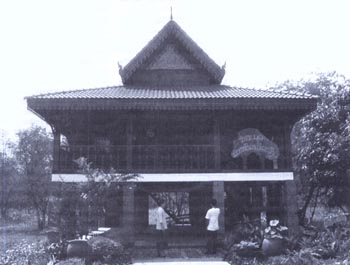
Now Tao Hung Tao Jeuang is available in the Thai and Lao languages. It is an extremely important historical document for the Tai-Lao cultural identity. In the future, one hopes, it will be translated into other Tai languages. It will also be available in the western languages, Chinese, and other languages used on the Asian continent. An invaluable knowledge system knows no boundaries, forming a Republic of Letters transcending geographical, political, and economic barriers, and standing the test of time. It can be said that Maha Sila was an heir to the literary and religious tradition from the time of King Mongkut Rama IV of Siam . King Rama IVs bicentenary was on 18 October 2004 . The present Thai ruling elites do not have the eye to see his ingenuity. Before he became king, Prince Mongkut was in the monkhood for 27 years. As a monk, he was known as Bhikkhu Vajirayana. Also, he was the spiritual teacher of Devadhammi Mao, a leading monk in the northeastern wing of the Dham-mayuti order which also spread into Champassak of Laos. Phra Upalikunupama cariya (Chan Si-ricando) ofUbonratchathani province was the main pillar maintaining this religious lineage for the third generation from Prince Mongkut until the time of Som-dej Phra Mahaveeravong (Ouan Tisso), who was the spiritual teacher of the monk named Maha Sila. Indeed, it was the Somdej who allowed Maha Sila to use his religious title as his surname. This constituted an inheritance from the supramundane to the worldly, from royalty to the common people, from Siam to Laos , propelled by the Wheel of Dhamma, which is transcendental. Moreover, that Siam was able to veer towards modernity while maintaining dhammic substance without succumbing to western colonialism was in large part due to the ingenuity of King Rama IV in both the spiritual and worldly realms. Thus when Siam constructed the first public library of the capital, it was named Vajirayana Library after King Mongkut's religious name in the monkhood. When Prince Damrong Rajanubhab, one of the King's sons, was given charge of the Library, he turned it into a major institutional pillar upholding and cultivating pride in the Thai language, culture, traditions, and history. This served as an important foundation for the Republic cf Letters. Although Phya Anuman Rajadhon was not related by blood to royalty, Prince Damrong greatly admired and held him as part of his kin in the Republic of Letters . Maha Sila Viravong had worked closely with Phya Anuman, and not only inherited a great deal of literary skills and knowledge from the latter but also from Prince Damrong. His history of Laos , anthology of Laotian traditional stories and folklores, and revision of Laotian literature on spiritual as well as worldly matters can be traced back to the lines of Damrong Rajanubhab and Anuman Raja-don. Nevertheless, he also maintained a high degree of independence .and originality. For instance, he sided with Prince Petcharat, the viceroy of Laos , in demanding for Laotian independence from France . Here independence not only means political independence. It also entails intellectual independence, which must go together with beauty and goodness. Truth-fulness is the essence of peace. The Vaj irayana Library became a foundation that promoted interest in the new knowledge system of Siam akin to what the Royal Society did in Britain and the Academic des Sciences did in France . Let us all hope that the Maha Sila Viravong Library will fulfill a role comparable to the three aforementioned institutions. The Vajirayana Library is a symbol of excellence because of patrons like Prince Damrong and Phya Anuman. .Likewise, the Maha Sila Viravong Library will need to find individuals to build on the work initiated by his two leading daughters: Mrs-Dara Kalaya and Mrs. Duangduen Bunyavong. With this good will, I invite all guests to help unveil the Maha Sila Viravong Library. May it be a bright light in the Republic of Letters forever. [Excerpted from Sulak Siva-raksa's speech on the grand opening day of Maha Sila Viravong Library at the Thousand Bamboo Grove, Vientiane . Laos . It was held on 25 December 2004 . The centenary of Maha Siia Viravong will actually be on 1 August 2005 .]
--------------------------------------
|

|
For Thai language see the sister-website
www.semsikkha.org Copyright © 2001 SATHIRAKOSES-NAGAPRADIPA FOUNDATION You can contact the webmaster here: [email protected] |
![[*]](../web/images/bullet1.gif)